Carnivorous plants
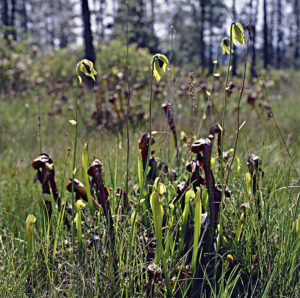
California pitcher plant, or cobra plant (Darlingtonia californica), is the only species of pitcher plant in western United States, here photographed at Cave Junction, Oregon. (Photo copyright © by Kaj Halberg)
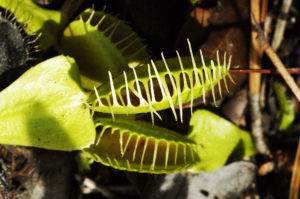
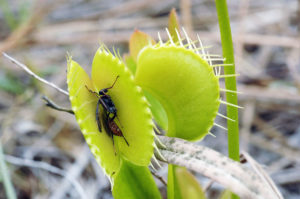
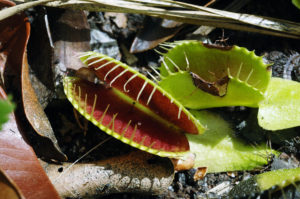
British naturalist Charles Darwin (1809-1882) called the Venus flytrap (Dionaea muscipula) “one of the most wonderful plants of the world.” – One of the traps on this plant, growing in Carolina Beach State Park, North Carolina, has shut, when two of the three trigger hairs inside the trap were touched within a certain period of time. (Photo copyright © by Kaj Halberg)
Most flesh-eating plants have one thing in common: They grow in nitrogen-poor soils. To obtain the necessary nutrients, they have evolved various means of catching insects and other small invertebrates. Enzymes, produced by the plants, break down the outer chitin layer of the animals, while bacteria, or other enzymes, make nitrogen and other nutrients in the animals digestible for the plant.
Pitcher plants
Pitcher plants belong to five genera, which have one character in common: their leaves are highly modified, forming trumpet-, tube-, or bag-shaped pit-fall traps, called ‘pitchers’, which contain fluid. These plants emit fragrance, luring insects and other tiny animals into the trap. If these animals do not immediately drown in the fluid, they are prevented from escaping by various means.
Nepenthaceae
This family contains only a single genus, Nepenthes, with around 180 species, most of which are found in Southeast Asia and the Indonesian Archipelago, with a few species in Madagascar, the Seychelles, north-eastern India, Bangladesh, Sri Lanka, New Guinea, eastern Australia, and New Caledonia.
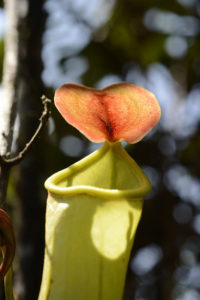
Most species are climbers, often several metres long. The midrib of the leaf is prolonged into a tendril, which forms a globe- or tube-shaped pitcher. Usually, two types of pitchers are produced, larger ones near the ground, and smaller ones higher up. The ‘lip’, or peristome, around the upper edge of the pitcher is very slippery, causing tiny animals to slide into the trap. The fluid in the pitcher is viscoelastic, causing winged insects to be unable to escape. Along the inner edge is a row of stiff, down-pointing hairs, which prevent prey from escaping. Above the peristome is an umbrella-like cover, the operculum, the purpose of which is to prevent excess rainfall into the pitcher.
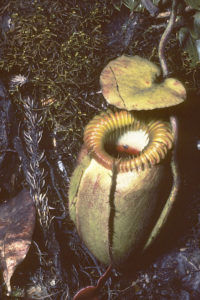
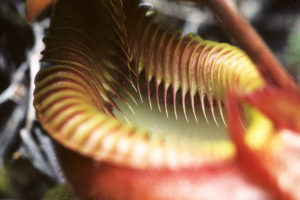
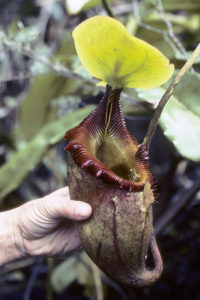
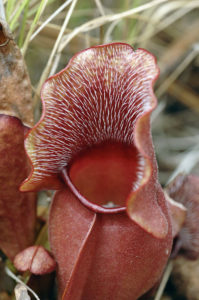
Borneo is home to many species of pitcher plants. Nepenthes villosa, shown here, is quite common in Gunung Kinabalu National Park, Sabah. The lower picture shows the peristome, equipped with a row of stiff, down-pointing hairs, which prevent prey from escaping. (Photos copyright © by Kaj Halberg)
Two Sri Lanka pitcher plants (Nepenthes distillatoria), encountered in Sinharaja Forest Reserve, south-western Sri Lanka. This species is endemic to Sri Lanka. (Photos copyright © by Kaj Halberg)
Large species of pitcher plants occasionally catch small vertebrates, such as mice and lizards. This picture shows a large natural hybrid, Nepenthes villosa x N. rajah, known as N. x kinabaluensis, encountered in Gunung Kinabalu National Park, Sabah, Borneo. (Photo copyright © by Kaj Halberg)
Sarraceniaceae
This family contains 3 genera, restricted to America.
Sarracenia Trumpet pitcher plants
This genus contains 8 to 14 species, depending on authority. It is distributed from western Canada eastwards to the Great Lake area, Labrador, and Newfoundland, and thence southwards through the easternmost United States southwards to Alabama and Florida. Like Nepenthes, these plants are equipped with a slippery peristome, and an operculum.
Sarracenia flava Yellow pitcher plant
This species has narrow, trumpet-shaped pitchers, which can grow to a height of almost 1 m. It is distributed from southern Virginia southwards through the Carolinas to Georgia, Alabama, and Florida. A reddish form is sometimes seen.
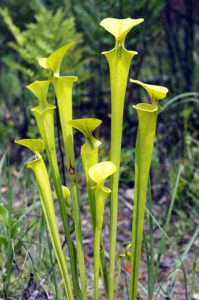
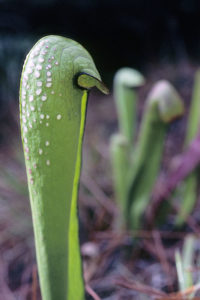
Yellow pitcher plant, Carolina Beach State Park, North Carolina. (Photo copyright © by Kaj Halberg)
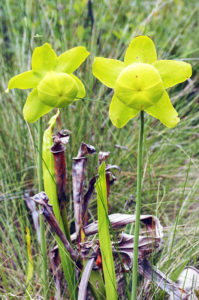
Flowers of yellow pitcher plant, Green Swamp Preserve, North Carolina. (Photo copyright © by Kaj Halberg)
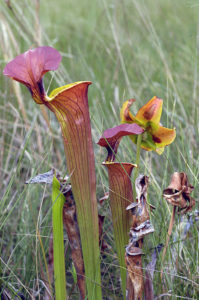
Reddish form of yellow pitcher plant, Green Swamp Preserve. (Photo copyright © by Kaj Halberg)
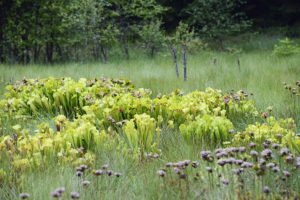
Yellow pitcher plant and purple pitcher plant (below) have both been widely introduced to Europe, and they are often illegally planted in marshes, where they tend to become invasive, if they are not controlled in time. This picture shows a mixed growth of the two species in a marsh in central Jutland, Denmark. (Photo copyright © by Kaj Halberg)
Sarracenia purpurea Purple pitcher plant
Most members of this genus have tall, narrow pitchers, but in this species they are short and rather broad, sitting close to the ground. It is the most widely distributed member of the genus, found in the major part of southern Canada and in easternmost United States. It is the official flower of Newfoundland and Labrador.
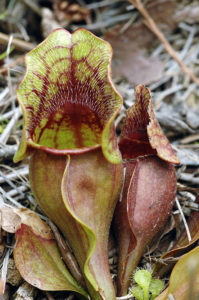
Purple pitcher plant, Green Swamp Preserve, North Carolina. Note the numerous stiff, down-pointing hairs in the pitcher, which prevent prey from escaping. (Photos copyright © by Kaj Halberg)
Sarracenia minor Hooded pitcher plant
As opposed to other members of the genus, the operculum of this species forms a hood over the pitcher. This plant and S. psittacina are the only members of the genus to have translucent patches on the pitcher, which confuse prey species. As they try to escape through these ‘windows’, they are lured further into the pitcher, away from the entrance. Hooded pitcher plant is restricted to the south-eastern United States, found from southern North Carolina southwards to central Florida.
Hooded pitcher plant, Okefenokee Swamp, Georgia. (Photo copyright © by Kaj Halberg)
Darlingtonia
This genus contains only a single species, the California pitcher plant (D. californica), which is restricted to scattered locations in northern California and western Oregon. It is the only pitcher plant in the western United States.
This plant, also known as cobra plant, was discovered in 1841, and in 1853 it was described by American botanist, chemist, and physician John Torrey (1796-1873), who named it Darlingtonia, in honour of botanist William Darlington (1782-1863) of Philadelphia.
Fragrance from nectar, emitted by the plant, lures insects into the long, tube-shaped pitchers, which are filled with fluid.
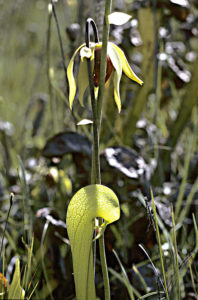
Flowering California pitcher plant, Cave Junction, Oregon. (Photo copyright © by Kaj Halberg)
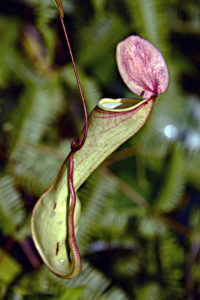
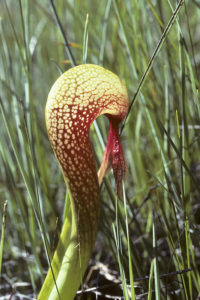
A brightly coloured pitcher with numerous translucent spots, which lure prey away from the entrance, similar to certain Sarracenia species (see above). – Cave Junction, Oregon. (Photo copyright © by Kaj Halberg)
Heliamphora
The third genus contains about 18 species, all endemic to northern South America. Popularly, they are known as sun pitcher plants or marsh pitcher plants.
Cephalotaceae
This family contains only a single genus with a single species, Cephalotus follicularis. It is restricted to a small area in south-western Australia.
Lentibulariaceae Butterwort family
A worldwide family with 3 genera and about 420 species of herbs, most of which are found in tropical areas. 2 genera are presented below. The third one, Genlisea, comprising about 30 species, is found in Latin America and in Africa south of the Sahara.
Pinguicula Butterworts
Butterworts have succulent leaves with glands, producing droplets, which lure tiny insects and other invertebrates to the sticky surface of the leaf. Once an animal begins to struggle, trying to escape, more mucilage is produced, while other glands release enzymes, which break down the chitin layer of the animal, making it possible for the plant to absorb nitrogen from it.
About 120 species of butterwort are presently known, with the largest number found in Central and South America, while 12 species are native to Europe, 9 to North America, and a few to northern Asia.
The generic name is diminutive of the Latin pinguis (‘fat’ – compare the word ‘penguin’), which, like the common name butterwort, refers to the slimy and fatty leaves. This slime was applied to cracks in cow udders. On an excursion in 1747, an apprentice of Swedish naturalist Carl Linnaeus (1707-1778), says that ”in Switzerland, Pinguicula is used externally on fissuris mammarum, even if the udder becomes hardened, so that it will milk blood.”
Formerly, in large parts of northern Europe, a common practice was to apply leaves of butterwort to milk to make it separate or thicken. German farmers would place butterwort plants in water, later using this water to make tough or newly cut meat tender.
In folk medicine, the plant has mostly been used to heal wounds and various skin problems. In Denmark, in the 1900s, when many children were suffering from ringworm and other skin ailments, the affected parts were smeared with butter, or leaves of butterwort.
In his thesis from 1688, De usu plantarum, Danish herbalist Ole Borch recommends butterwort for treatment of ”hectica febris legitima [consumption] and hernia.” You must apply a compress of milk, he says, mixed with moss or butterwort roots on the affected parts, not only for healing, but also to give it back its natural humidity.
In the old days, in Denmark, farmers were convinced that if sheep would consume butterwort “before Michaelmas” (September 29), they would get liver flukes (Distoma hepaticum). However, the biological explanation is that the sheep got these parasites by grazing in wet areas, where not only butterwort thrives, but also the flukes.
Pinguicula vulgaris Common butterwort
This plant has a circumboreal distribution, distributed in most of Europe, Russia, Canada, and the United States.
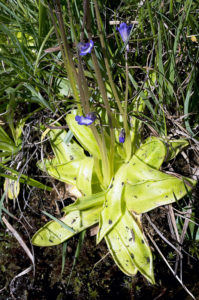
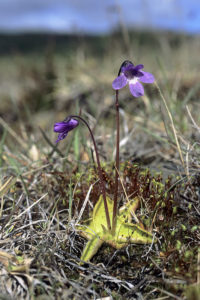
Common butterwort with remains of digested insects on their leaves, photographed on the island of Bornholm, Denmark (top), and in Aðaldal Valley, northern Iceland. (Photos copyright © by Kaj Halberg)
Pinguicula alpina Alpine butterwort
This species often forms dense stands through vegetative growth. It is widely distributed, found in montane areas of Europe, in the Himalaya, and along Arctic shores, from northern Scandinavia eastwards through Siberia. In 2012, a population was found as far north as Svalbard.
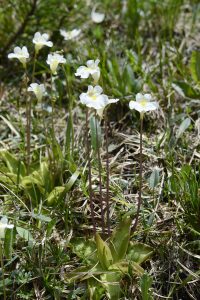
Alpine butterwort is rather common in the Alps. These were observed near Prehodavci, Triglavski National Park, Slovenia. (Photo copyright © by Kaj Halberg)
Pinguicula spathulata Spathulate butterwort
This beautiful plant is restricted to eastern Siberia. Some authorities call it P. variegata.
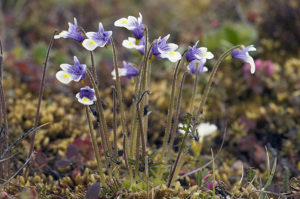
Spathulate butterwort, photographed on the Chukotka Peninsula. (Photos copyright © by Kaj Halberg)
Utricularia Bladderworts
Bladderworts, comprising around 270 species, has a very wide distribution, found in almost all parts of the world.
Members of this genus capture small animals by means of bladder-like traps. The pressure inside the bladder is negative, compared to its surroundings. When trigger hairs on the trapdoor is touched by a tiny animal, the prey, along with the water around it, is sucked into the bladder, whereupon the door closes again, the whole procedure lasting only 1/10,000th of a second.
This genus contains aquatic as well as terrestrial species. Aquatic species catch larger prey like water fleas and nematodes, whereas terrestrial species catch tiny organisms like protozoa and rotifers.
Utricularia australis Southern bladderwort
The geographic range of this plant is vast, covering Europe, most of Asia, the southern half of Africa, Australia, and New Zealand. The specific and common names refer to the fact that this species was described from a specimen, which was collected in Australia in 1810.
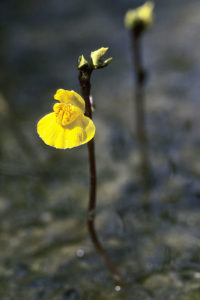
Southern bladderwort, Zealand, Denmark. (Photo copyright © by Kaj Halberg)
Utricularia macrorhiza Greater bladderwort
In North America, this species replaces the common bladderwort (U. vulgaris) of Europe and Asia, which it closely resembles.
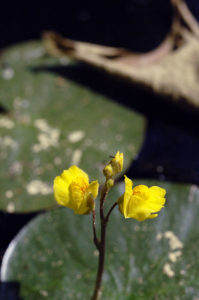
Greater bladderwort, Crystal Lake Conservation Area, Haverhill, Massachusetts. In the background leaves of fragrant water-lily (Nymphaea odorata). (Photo copyright © by Kaj Halberg)
Utricularia minor Lesser bladderwort
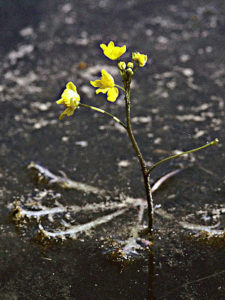
This tiny plant may be identified by its pale-yellow flowers, which are only 5-8 mm long, with a very short spur. It is circumboreal, found in Europe, northern Asia, and North America.
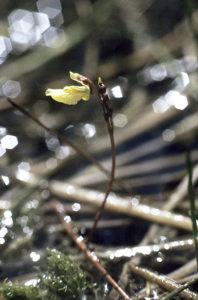
Lesser bladderwort, Jutland, Denmark. (Photo copyright © by Kaj Halberg)
Utricularia inflata Inflated bladderwort
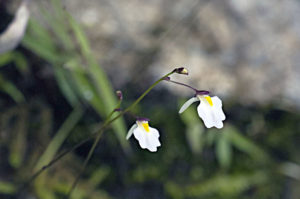
This species, also known as swollen bladderwort or large floating bladderwort, is distributed in eastern and south-eastern United States. It has been introduced to Washington State, where it is considered an invasive plant. Two of its names refer to the inflated leafstalks.
Inflated bladderwort, Cape May State Park, New Jersey. (Photo copyright © by Kaj Halberg)
Utricularia brachiata
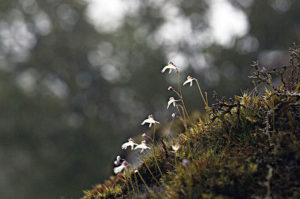
This tiny plant is one of the terrestrial species of bladderwort, catching minute prey, such as protozoa and rotifers. It is distributed in forests between 2,000 and 4,200 m altitude in the Himalaya, eastwards to the Chinese provinces Sichuan and Yunnan.
Utricularia brachiata, growing among moss on a rock, Langtang National Park, central Nepal. (Photos copyright © by Kaj Halberg)
Droseraceae Sundew family
This family with 3 genera is found in most parts of the globe. 2 genera are presented below. The third, Aldrovanda, contains a single species, widespread in Eurasia, Africa, and Australia.
Drosera Sundew
A large genus with about 250 species, widely distributed on all continents, with the exception of Antarctica.
Members of this genus obtain the major part of their nutrients by catching small invertebrates by means of glandular hairs on their leaves. When an animal gets stuck in the sticky juice from these glands, the leaf envelops the unfortunate victim, whereupon enzymes dissolve its body juices, making nitrogen and other nutrients available for the plant.
These plants are called sundew due to their sticky glandular hairs, which resemble dew drops, when the sun is shining on them. Formerly, in European folk medicine, dew drops were said to possess miraculous qualities, and the glandular ‘drops’ of sundew were sold as Virgin Mary’s tears. Supposedly, they were able to cure skin diseases like warts, ringworms, and corns, besides many other ailments.
In the old days, in Denmark, farmers were convinced that if sheep would consume sundew “before Michaelmas” (September 29), they would get liver flukes (Distoma hepaticum). The real cause for the sheep to get these parasites was that they were grazing in wet areas, where not only these plants thrive, but also the flukes.
Drosera rotundifolia Round-leaved sundew
This species has a huge distribution, found in North America, the major part of Europe, the Caucasus, Siberia, Korea, and Japan. The occurrence of a population in New Guinea is most odd, and it may constitute a separate species.
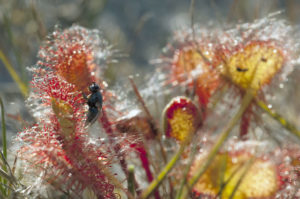
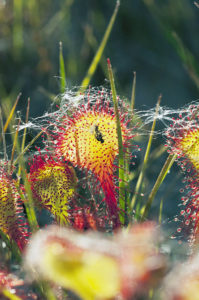
In these two pictures from the island of Bornholm, Denmark, flies have been caught in glandular hairs of round-leaved sundew. The fluffy, whitish hairs are seeds of willow (Salix). (Photos copyright © by Kaj Halberg)
Drosera intermedia Oblong-leaved sundew
This plant, also called spoon-leaved sundew, is also very widely distributed, occurring in Europe, the eastern half of North America, northern South America, and Cuba.
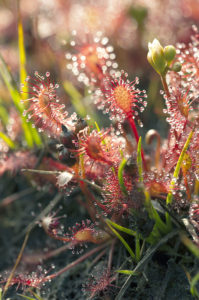
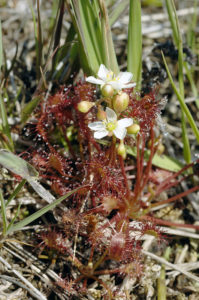
Oblong-leaved sundew, photographed on the island of Fanø, Denmark. (Photos copyright © by Kaj Halberg)
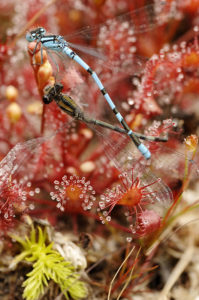
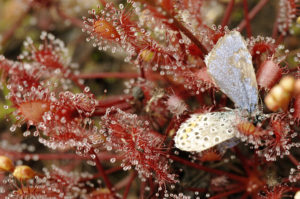
These pictures from Jutland, Denmark, show insects, which have been trapped in glandular hairs of oblong-leaved sundew, two common blue damselflies (Enallagma cyathigerum, top), of which one has already dried out, while the other one has just been caught. The lower picture shows a species of butterfly, of the family Lycaenidae. (Photos copyright © by Kaj Halberg)
Drosera peltata Crescent-leaved sundew
This species is distributed in montane areas, from the Himalaya eastwards to Southeast Asia, and thence southwards through the Indonesian Archipelago to Australia.
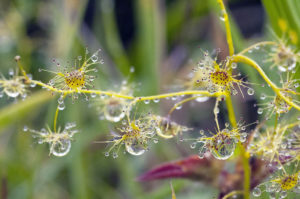
The leaves of this crescent-leaved sundew, encountered in Langtang National Park, central Nepal, are heavy with rain drops, following a monsoon shower. (Photo copyright © by Kaj Halberg)
Dionaea
A genus with only a single member, the Venus flytrap (D. muscipula). It is widely cultivated as a house plant around the world, but has a very limited distribution in the wild, found only in a few locations in North and South Carolina, United States. Populations in New Jersey may be escapes from cultivation.
It was described in 1759 by North Carolina governor Arthur Dobbs (1689-1765), who wrote: “But the great wonder of the vegetable kingdom is a very curious unknown species of sensitive; it is a dwarf plant; the leaves are like a narrow segment of a sphere, consisting of two parts, like the cap of a spring purse, the concave part outwards, each of which falls back with indented edges (like an iron spring fox trap); upon any thing touching the leaves, or falling between them, they instantly close like a spring trap, and confine any insect or any thing that falls between them; it bears a white flower: to this surprising plant I have given the name of ‘Fly Trap Sensitive’.”
Venus flytrap was highly praised by Swedish naturalist Carl Linnaeus (1707-1778), who called it a “miraculum naturæ”, and by British naturalist Charles Darwin (1809-1882), who labelled it “one of the most wonderful plants of the world.”
This species is unique among flesh-eating plants in having highly modified leaves, which act like a snap-trap, when stimulated in a certain way. On the inner surface of the trap are three stiff hairs, and two of these must be stimulated within a short period of time to trigger the trap. This mechanism has been developed to prevent the plant from using energy on shutting the trap, if e.g. a withered leaf by chance falls into it. Thick, stiff protrusions, or cilia, along the edge of the trap form ’bars’, which prevent prey from escaping.
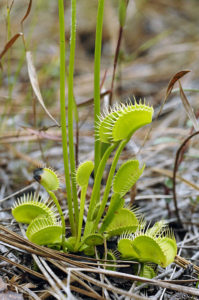
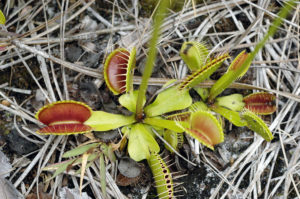
Venus flytrap, Green Swamp Preserve, North Carolina. In the bottom picture, a trap has opened, when the nutrients of a trapped insect have been utilized. (Photos copyright © by Kaj Halberg)
A new leaf of Venus flytrap, opening up, Carolina Beach State Park, North Carolina. (Photo copyright © by Kaj Halberg)
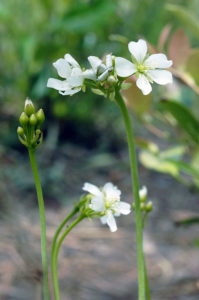
Flowering Venus flytrap, Carolina Beach State Park. (Photo copyright © by Kaj Halberg)
Drosophyllaceae
Drosophyllum lusitanicum Portuguese sundew
This species, the only member of the family, has a restricted distribution, found only in Spain, Portugal, and Morocco. Formerly, it was regarded as belonging to the sundew family (above), but has now been placed in a separate family.
Portuguese sundew is one of the few carnivorous plants, which is able to thrive on dry, alkaline soils. The leaves, which are 20 to 40 cm long, uncoil from a central rosette. The plant emits a sweet aroma, which attracts insects. When they land on a leaf, or on the stem, they get stuck in the numerous sticky glandular hairs.
Portuguese sundew, encountered near Cortes de la Frontera, Andalusia, Spain. (Photo copyright © by Kaj Halberg)
References
Brøndegaard, V.J. 1961. Vibefedt i folkemedicinen. Farmaceutisk Tidende 71, pp. 957-962. Taken from: Håkan Tunón (ed.). Etnobotanik. Planter i skik og brug, i historien og i folkemedicinen. Vagn J. Brøndegaards biografi, bibliografi og artikler i udvalg på dansk, Vol. 1, pp. 507-513. Published by Centrum för biologisk mångfald, Uppsala, & Kungl. Skogs- och Lantbruksakademien, Stockholm, 2015. (In Danish)
Dillwyn, L.W. 1843. Hortus Collinsonianus. An account of the plants cultivated by the late Peter Collinson.
(Uploaded August 2016)
(Latest update November 2022)