Rise and fall of the mighty elephants
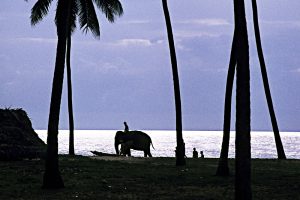
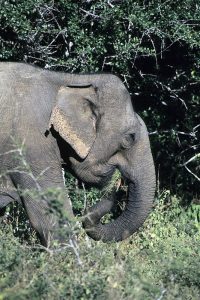
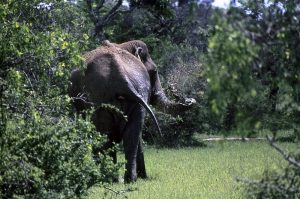
Asian elephant, Negombo, Sri Lanka. (Photo copyright © by Kaj Halberg)
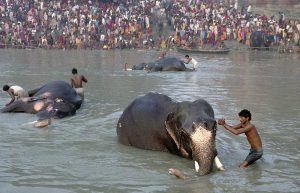
These Asian elephants enjoy being washed by their mahouts (trainers) in the Gandak River, Sonpur, Bihar, northern India. The huge crowd of people in the background are Hindu pilgrims, participating in the annual November pilgrimage to this river. (Photo copyright © by Kaj Halberg)
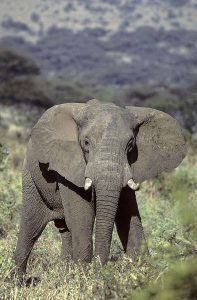
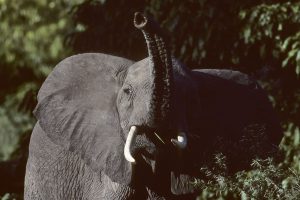
This savanna elephant bull is waving his ears, indicating his annoyance with the presence of our vehicle, Tarangire National Park, Tanzania. (Photo copyright © by Kaj Halberg)
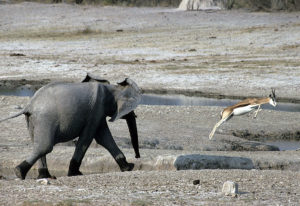
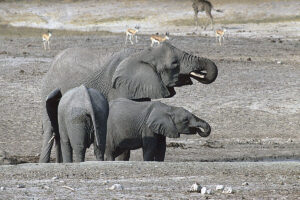
This young savanna elephant, which was drinking from a stream in Etosha National Park, Namibia, seems to be annoyed by the presence of a Kalahari springbuck (Antidorcas marsupialis). (Photo copyright © by Kaj Halberg)
There were white-tusked wild males, with fallen leaves and nuts and twigs lying in the wrinkles of their necks and the folds of their ears; fat, slow-footed she-elephants, with restless, little pinky black calves only three or four feet high running under their stomachs; young elephants with their tusks just beginning to show, and very proud of them; lanky, scraggy old-maid elephants, with their hollow anxious faces, and trunks like rough bark; savage old bull elephants, scarred from shoulder to flank with great weals and cuts of bygone fights, and the caked dirt of their solitary mud baths dropping from their shoulders; and there was one with a broken tusk and the marks of the full-stroke, the terrible drawing scrape, of a tiger’s claws on his side.
They were standing head to head, or walking to and fro across the ground in couples, or rocking and swaying all by themselves – scores and scores of elephants.
From Toomai of the Elephants, a story in The Jungle Book (1894), by English author and journalist Rudyard Kipling (1865-1936).
The first elephant-related animals, Eritherium and Phosphaterium, appeared on Earth during the late Palaeocene, about 60 million years ago. However, they resembled tapirs more than modern elephants. From these ancestors, numerous forms evolved. Altogether c. 161 species are known, belonging to five separate families.
In former times, elephants were distributed throughout Eurasia, Africa, and North America, living in a wide variety of habitats and climates, hot and cold. They also varied enormously in size, from giants more than 4 m tall, to dwarves, which stood only 1-1.5 m tall. The latter evolved on isolated islands, including Malta, Cyprus, and Crete in Europe, and the Channel Islands in America, off the Californian coast.
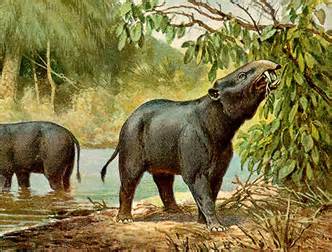
Eritherium, the earliest and smallest relative of the elephants, lived about 60 million years ago. (Illustration: Public domain)
Present-day elephants
All of these species, but three, have since become extinct. In North America, the mastodon (Mammut americanum) survived until about 10,000 years ago. Presumably, it was eradicated by hunting tribes, which had migrated here from Siberia during the last Ice Age, when, during several separate periods, a land bridge linked Asia with America, across the Bering Strait. The woolly mammoth (Mammuthus primigenius), which lived in Eurasia, survived even longer in Siberia, the last ones dying out only about 4,000 years ago, on the island of Wrangel.
Two of the three surviving species live in Africa, one in Asia. Formerly, the savanna elephant (Loxodonta africana) was distributed all over the African continent, with the exception of deserts and rainforest areas. Today, it is restricted to savannas and semi-deserts in eastern and southern Africa. The closely related, but smaller forest elephant (Loxodonta cyclotis) lives in rainforests of Central and West Africa. Some scientists still consider the savanna elephant and the forest elephant as belonging to the same species.
Formerly, the Asian elephant (Elephas maximus) was distributed across Asia, from Asia Minor in the west to northern China in the east, and southwards into Indonesia. Today, it is restricted to small pockets of forest in India, Nepal, Sri Lanka, the Yunnan Province of southern China, Southeast Asia, and on Sumatra and Borneo.
The origin of the Bornean elephant, subspecies borneensis, which is much smaller than other Asian elephants, remains the subject of debate. Some claim that it is descended from introduced elephants. New research, however, states that it may have been living in Borneo for more than 10,000 years. Some scientists even regard it as a separate species, Elephas borneensis.
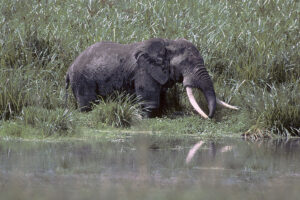
A 60-year old bull savanna elephant may have tusks weighing 60 kilos each. This large bull is feeding in a swamp in the Ngorongoro Crater, Tanzania. The savanna elephant has much larger ears than the forest elephant and the Asian elephant. (Photo copyright © by Kaj Halberg)
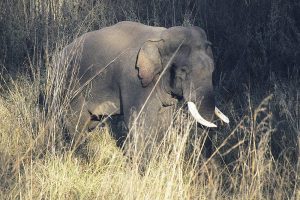
The Asian elephant is somewhat smaller than the savanna elephant, but is still a very large animal. This bull is grazing in Corbett National Park, Uttarakhand, India. Note the secretion on the side of its head (see musth in next section). (Photo copyright © by Kaj Halberg)
Social animals
Elephants are huge creatures. The savanna elephant is the largest land animal on Earth, a normal bull weighing 5 to 6 tons, a cow around 3 tons. The heaviest elephant ever recorded was a bull, shot in Angola in 1955, which weighed 10 tons and stood more than 4 m tall across the shoulder. On average, a forest elephant weighs only about half as much as a savanna elephant. The Asian elephant is somewhat smaller than the savanna elephant, measuring to 3 m tall across the shoulder, the bull weighing a maximum of 5 tons.
Elephants are very social, living in herds. Smaller herds are family units, led by a matriarch, which is the oldest cow in the herd, with her daughters and their offspring. Young bulls leave the herd, when they reach puberty, living alone or in loose-knit male groups. Sometimes younger females leave the group to form their own herd. However, they still keep in contact with their maternal herd, and smaller groups often join to form larger herds for shorter or longer periods, occasionally comprising hundreds of animals.
Ovulation of females is normally linked to the season of abundance, i.e. the end of the wet season. In periods of drought and famine they simply do not ovulate. When females are receptive, bulls travel long distances to seek them out.
When bulls are in rut, secretions ooze from a gland on the side of their head, signifying a higher production of male hormones, a condition called musth. During musth, bulls are highly aggressive, and tamed Asian elephants in musth have been known to kill their mahout (trainer), without any apparent reason.
The gestation period is almost two years. A new-born savanna elephant calf weighs about 120 kilos, an Asian about 100 kilos. Six years old, the calf weighs about a ton.
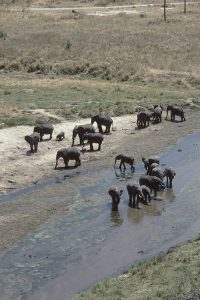
Elephants are social creatures. Here, a herd of savanna elephants are drinking from a stream, Tarangire National Park, Tanzania. (Photo copyright © by Kaj Halberg)
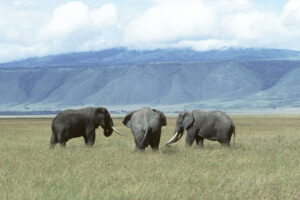
Even though young bull elephants leave the herd to live a solitary life, they often form small, loose-knit groups, like this one in the Ngorongoro Crater, Tanzania. (Photo copyright © by Kaj Halberg)
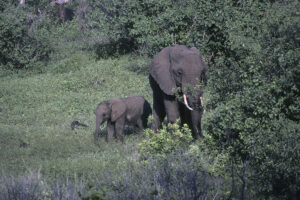
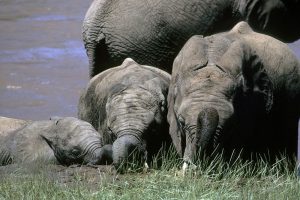
A new-born savanna elephant calf weighs about 120 kilos. These pictures are from Lake Manyara National Park, Tanzania. (Photos copyright © by Kaj Halberg)
A new-born Asian elephant calf weighs about 100 kilos. This picture was taken in an elephant breeding centre near Chitwan National Park, southern Nepal. (Photo copyright © by Kaj Halberg)
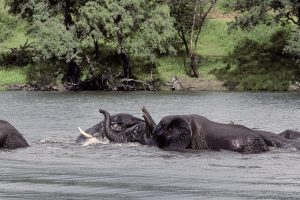
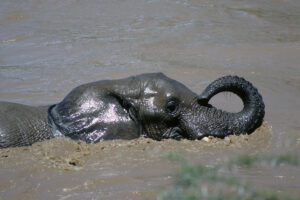
Elephants love bathing, occasionally diving, using their trunk as a snorkel. These pictures show savanna elephants in the Chobe River, northern Botswana (top), and in Ewaso Nyiro River, Samburu National Park, Kenya. (Photos copyright © by Kaj Halberg)
The trunk
Apart from their great size, elephants have a number of unique characteristics. The trunk is in fact the combined nose and upper lip, which have been elongated. The trunk developed, as the elephants grew larger during the Miocene Period, about 20 million years ago, probably to allow them to survive on vegetation with low nutritional value. Because of the heavy weight of their head, they could not develop a longer neck, so instead the trunk was formed. Among its functions are: up-rooting grass tufts; tearing off bark and twigs of trees; picking fruits; smelling; drinking by sucking up water and sprouting it into the mouth; sucking up mud for a mud-bath or dust for a dust-bath; or even to be used as a snorkel when swimming.
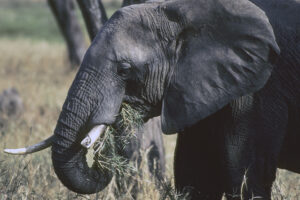
The trunk has numerous functions, such as up-rooting grass tufts. – Savanna elephant, Tarangire National Park, Tanzania (top), and Asian elephant, Yala National Park, Sri Lanka. (Photos copyright © by Kaj Halberg)
… smelling. – Savanna elephant, Lake Manyara National Park, Tanzania. (Photo copyright © by Kaj Halberg)
… drinking by sucking up water and sprouting it into the mouth. – Savanna elephants, Etosha National Park, Namibia. In the background springbuck (Antidorcas marsupialis) and a giraffe. (Photo copyright © by Kaj Halberg)
… sucking up mud for a mud-bath. – Asian elephant, Yala National Park, Sri Lanka. (Photo copyright © by Kaj Halberg)
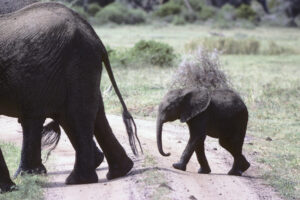
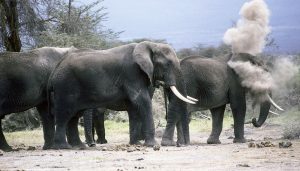
… or dust for a dust-bath. – Savanna elephants, Amboseli National Park, Kenya. (Photo copyright © by Kaj Halberg)
The tusks
Another unique characteristic is the tusks. These are two elongated incisors, appearing at an age of about two years and growing throughout the elephant’s life. They consist of a mixture of dentine and calcium salts, called ivory. The bull’s tusks are much larger than the cow’s. A 60-year old bull savanna elephant may have tusks weighing 60 kilos each, whereas the tusks of a cow of similar age only weigh about 9 kilos each. The record is a stunning 130 kilos, and a length of 3.5 m.
In former days, these great tuskers were the prime target of trophy hunters, and today no such animals exist. The Asian bulls have smaller tusks than the savanna elephant, and those of the cows are very small indeed. In the Sri Lankan subspecies, maximus, only 10% of the bulls grow tusks, the cows none at all. This trend has been reinforced by poachers, who select the bulls with the largest tusks.
The tusks are used for various purposes. Here, young savanna elephants are digging out soil from a river bank to eat minerals. – Ewaso Nyiro River, Samburu National Park, Kenya. (Photo copyright © by Kaj Halberg)
Elephants and people
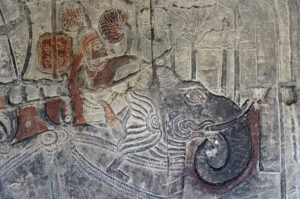
The Asian elephant was first tamed in the Indus Valley about 5,500 years ago. Since its taming, it has been much utilized by people to pull or carry heavy burdens. In the Hindu Khmer culture of Indochina, royalty and other prominent persons were riding on elephants, when they went on hunting trips to shoot tigers and other big game. Elephants were also much used in Khmer warfare, and during the British colonial wars in India in the 1800’s, elephants hauled heavy cannons to the battlefields.
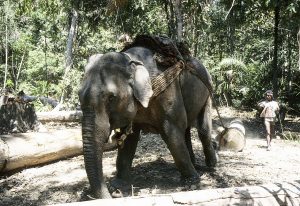
Until recently, in India and Southeast Asia, elephants were much used in the timber industry to haul out tree trunks from hilly forests. This usage continues today on a small scale in areas, which cannot be entered by heavy vehicles.
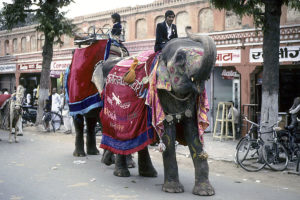
In India and Sri Lanka, elaborately adorned elephants are much used in processions during religious festivals.
In some national parks of Asia, elephants are utilized in the tourist industry, carrying people on wildlife watching trips. The elephants move silently through the forest, and tourists can get very close to wild animals, as most of them have no fear of elephants.
The savanna elephant is much more difficult to domesticate than its Asian counterpart. About 2,000 years ago, it was tamed in northern Africa by the Carthageans, and Hannibal brought them across the Alps during his campaign against the Romans. Many of his elephants, however, perished in the cruel climate and difficult terrain of the mountains. Elephants have also been used in the timber industry in Zaire, but on a very small scale.
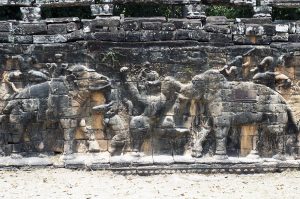
This Khmer frieze at Angkor Thom, Cambodia, is called The Terrace of Elephants. It depicts a royal hunt, during which trained elephants attack a lion and a wild water buffalo. (Photo copyright © by Kaj Halberg)
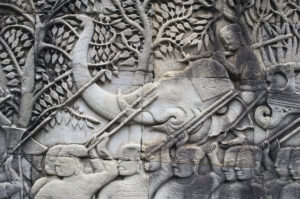
Khmer relief, depicting a prince on his elephant, his army on the march, with raised spears, Angkor Thom. (Photo copyright © by Kaj Halberg)
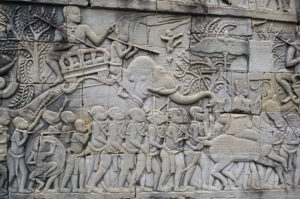
This Khmer relief depicts a procession with King Surayavarman II, riding into war with his army, Angkor Wat, Cambodia. (Photo copyright © by Kaj Halberg)
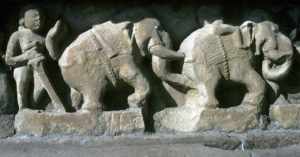
During the British colonial wars in India in the 1800’s, elephants hauled heavy cannons to the battlefields. This frieze, depicting war-elephants in a procession, is adorning the Vishvanath Temple in Khajuraho, Madhya Pradesh, India. (Photo copyright © by Kaj Halberg)
This elephant is hauling out a tree trunk from a forest in the Andaman Islands, Sea of Bengal. (Photo copyright © by Kaj Halberg)
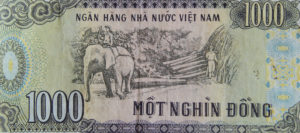
A timber-hauling elephant is shown on the Vietnamese 1000-Dong bill.
The role of the elephant in Hinduism
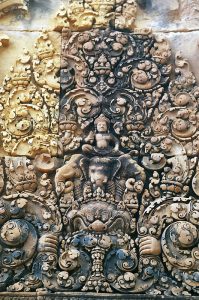
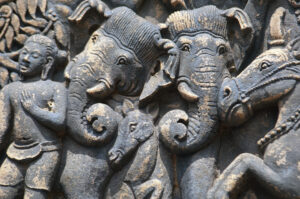
Following the contact between the Indus Culture and the invading Aryans from the steppes around the Caspian Sea, a new religion evolved, called Hinduism. In the Hindu pantheon, the three-headed elephant Airavata is the mount of the rain god, Indra, and elephants are much revered as a symbol of wisdom and power.
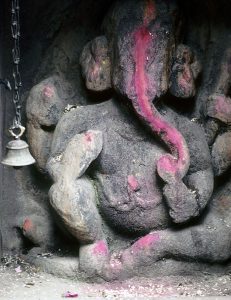
Ganesh, the youngest son of the supreme god Shiva and his female consort, Parvati, has a human body, but the head of an elephant. He is often depicted with his four arms raised in a friendly gesture, standing on his mount – which is a rat!
Ganesh loves sweets and fruit. He is a very popular god, and before making important decisions it is wise to pray before an image of Ganesh, placing a flower garland (malla) around its neck.
There are various legends as to how Ganesh got his elephant-head. According to one legend, it happened in this way:
One day, when Shiva was away on a longer journey, Parvati wanted to take a bath. She created a young man from clay to guard outside the house, while she was having her bath, ordering him not to let anybody enter the house.
Shortly after, Shiva returned from his journey, and the young man told him not to enter the house, as he was ordered. This made the fierce-tempered god so furious that he chopped off the young man’s head. This deed, however, made Parvati so angry that she threatened to destroy the universe, unless Shiva restored the young man’s head to his body. Sadly, his head had been destroyed, so Shiva ordered a servant to go outside the house and take the head of the first one he would meet.
This happened to be an elephant, and the servant, who took his master’s order literally, ordered the elephant to hand over his head.
Ganesh and other Hindu gods are described in depth on the page Religion: Hinduism.
Khmer relief at Banteay Srei, Angkor, Cambodia, depicting Indra, the Hindu rain god, riding on his three-headed elephant Airavata. (Photo copyright © by Kaj Halberg)
Crimson dye has been brought as an offering to this Ganesh sculpture in Kathmandu, Nepal. (Photo copyright © by Kaj Halberg)
Khmer relief, depicting the battle of Kurukshetra, an episode from the Hindu epic Mahabharata, Angkor Wat. (Photo copyright © by Kaj Halberg)
Khmer relief at Banteay Srei, Angkor, depicting a scene from the Hindu legend Fire in the Kandava Forest, with horror-stricken people and animals. This legend is releated in detail on the page Religion: Hinduism. (Photo copyright © by Kaj Halberg)
Procession with decorated elephants during the Hindu festival Maha Shivaratri, Jaipur, Rajasthan, India. (Photo copyright © by Kaj Halberg)
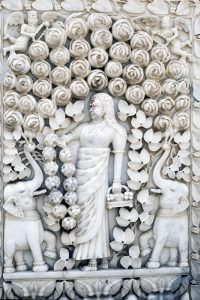
Marble relief, depicting a woman and elephants, in a Hindu temple, Karna Mata Mandir, Deshnok, Rajasthan, India. (Photo copyright © by Kaj Halberg)
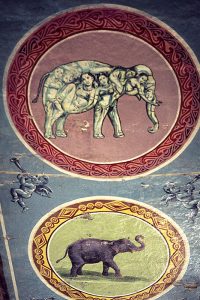
Decorated ceiling in a Hindu temple, depicting elephants, Rameshwaram, Tamil Nadu, India. Note that the upper painting is a double image: elephant and women. (Photo copyright © by Kaj Halberg)
The role of elephants in other religions
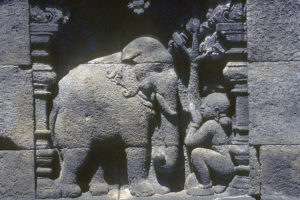
According to Buddhist mythology, on the night that Siddharta was concepted, Queen Maya, his mother, dreamed that an elephant had placed a lotus flower in her womb. – The Buddha and Buddhism are related in detail on the page Religion: Buddhism.
This relief at Borobodur, a Buddhist temple in Yogyakarta, Indonesia, is depicting Siddharta’s mother, Queen Maya. This grand temple was erected in the 8th Century A.D. (Photo copyright © by Kaj Halberg)
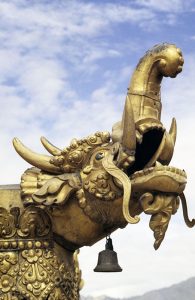
This Buddhist mythical creature, a horned elephant with lion teeth, adorns the Jokhang Temple in Lhasa, Tibet. – This temple is described on the page Travel episodes – Tibet 1987: Tibetan summer. (Photo copyright © by Kaj Halberg)
In Daoism, the elephant is regarded as a protector, and elephant sculptures are often placed at Daoist graves to guard the grave against evil forces, as this one in Taichung, Taiwan. – Daoism is described in depth on the page Religion: Daoism in Taiwan. (Photo copyright © by Kaj Halberg)
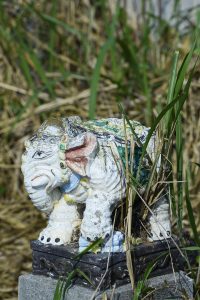
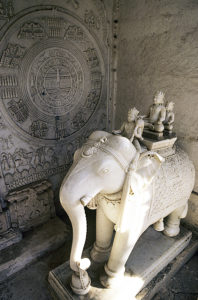
Carved elephant in a Jain temple atop the Shetrunjaya Hill, near Palitana, Gujarat, India. – This temple and other gorgeous Jain marble temples are presented on the page Religion: Jainism. (Photo copyright © by Kaj Halberg)
Threatened with extinction
In 1989, the African elephant was listed under Appendix I by the Convention on International Trade in Endangered Species of Wild Fauna and Flora (CITES), making trade illegal. Appendix II status, which allows restricted trade, exists in Botswana, Namibia, Zimbabwe, and South Africa, and in Botswana, Cameroun, Gabon, Mozambique, Namibia, South Africa, Tanzania, Zambia, and Zimbabwe there are export quotas for elephant trophies.
In 2008, the African elephant was listed as vulnerable by the International Union for Conservation of Nature (IUCN), but, unfortunately, there was no distinction between savanna elephant and forest elephant.
Ivory is much treasured for carving, especially by the Chinese, and this is the main reason for the decline of elephants worldwide. Officially, elephants are fully protected, and trade with ivory is strictly controlled. But in spite of these precautions, all three surviving species are threatened with extinction. In several places, almost all bulls have been shot by poachers. In Kerala in South India, for example, there are now 20 cows for every bull, and there may be too few bulls to mate with all cows.
Another big problem is that these huge animals are great wanderers and need large areas to survive. Everywhere across Asia and Africa, humans have encroached on elephant habitat, causing the elephants to eat crops, hereby becoming great pests. Naturally, people want to protect their crops, and there are many instances of people being killed, when they try to scare away elephants from their fields.
In many cases, it has become necessary to restrict the movements of elephants by erecting electrical fences or digging deep trenches, which the huge animals cannot cross. In some cases, whole herds of elephants have been eradicated, as they had become notorious crop raiders.
In all countries with populations of African elephants they are protected in national parks and game sanctuaries. However, in areas, where this protection is efficient, population densities often become too high, causing the elephants to destroy their own habitat. Previously, large-scale culling took place in these cases, but this practice ceased in 1988, and today numbers are controlled by contraception or translocation. However, most of their range (70%) is outside sanctuaries, and in these areas poaching is prevalent.
During the last 35 years, there has been a steady decline in numbers of African elephants. In 1979, the total population was estimated at 1.3 million, and possibly there were as many as 3 million. By 1989, this number had plummeted to about 609,000, of which c. 214,000 were forest elephants – a number much lower than had previously been thought. From 1977 to 1989, elephant populations declined by 74% in East Africa, and after 1987, the savanna elephant declined by 80% across Africa, from Cameroun to Somalia, and the forest elephant declined by 43%. In later years, this trend has ceased in eastern and southern Africa, and populations have increased by c. 4% per annum. In 2012, IUCN estimated a total of c. 440,000 African elephants (both species).
The current range of the Asian elephant is highly fragmented. In 2008, IUCN listed it as endangered due to a 50% population decline over the past 60-75 years. The total population of wild Asian elephants may now be as low as 40,000-50,000, or maybe even lower, as this number is an estimate. Researchers believe that about half of the population lives in India. In Sri Lanka, their number is c. 6,000 – half as many as in the 1800s. However, Sri Lanka still has the highest density of Asian elephants anywhere. Numbers are unknown in Southeast Asia, but only scattered herds exist. Almost everywhere the species is declining, particularly in Southeast Asia. It seems, however, that the population in West Ghats, South India, is increasing.
CITES has listed the Asian elephant under Appendix I, which means that trade in elephants and elephant products is illegal.
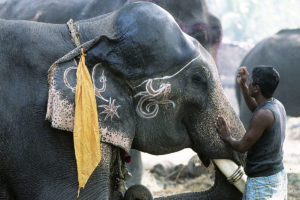
During the annual November market in Sonpur, Bihar, northern India, numerous types of domestic animals are sold, including tamed elephants. This one is being decorated with paint. (Photo copyright © by Kaj Halberg)
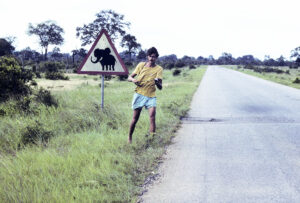
‘Elephants on the road’, Mikumi National Park, Tanzania. (Photo copyright © by Kaj Halberg)
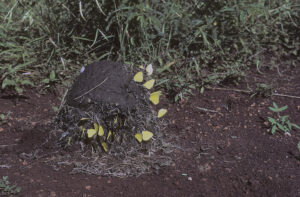
Dixeia butterflies, sucking moisture and nutrients from elephant dung, Meru National Park, Kenya. (Photo copyright © by Kaj Halberg)
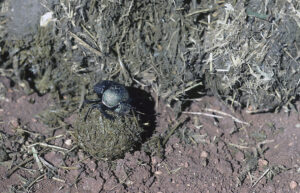
Dung beetle, making a ball out of elephant dung, after which it will roll it away, bury it and lay eggs in it. – Meru National Park, Kenya. (Photo copyright © by Kaj Halberg)
The lower part of the trunk of this old Taiwan red cypress (Chamaecyparis formosensis) resembles a kneeling elephant. – Alishan, Taiwan. (Photo copyright © by Kaj Halberg)
Ahmed of Marsabit
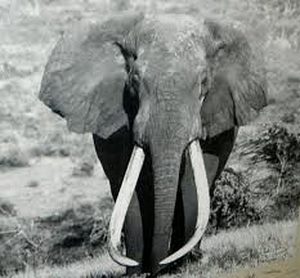
One of the most famous elephants ever was Ahmed – a huge tusker, who lived in Marsabit National Park in northern Kenya. Born around 1919, Ahmed grew to become a giant, with enormous tusks, which earned him the nickname ’The King of Marsabit’.
This elephant became so famous that president Jomo Kenyatta, in 1970, declared him ’a living monument’ – a national treasure protected by presidential decree. To avoid him being shot by poachers, Ahmed was guarded day and night by two appointed rangers, and he lived to die of old age in 1974, about 55 years old.
People always believed that his tusks were among the largest ever recorded, but, as it turned out after his death, they weighed ’only’ c. 67 kilos each – far less than other tusks recorded.
Today, a cast of Ahmed is exhibited in front of the National Museum in Nairobi.
Ahmed of Marsabit. (Photo: Public domain)
Sources
africahunting.com/threads/ahmed-the-elephant-of-marsabit.15201
en.wikipedia.org/wiki/Elephantidae
Blanc, J. 2008. Loxodonta africana. IUCN Red List of Threatened Species, version 2012.2. International Union for Conservation of Nature
Choudhury, A. et al. 2008. Elephas maximus. IUCN Red List of Threatened Species, version 2012.2. International Union for Conservation of Nature
Daniel, J. C. 1998. The Asian Elephant – a natural history. Natraj Publishers
Jayewardene, J. 2012. Elephants in Sri Lankan History and Culture. Living Heritage Trust
(Uploaded February 2016)
(Latest update October 2022)